The Trade-Off Space of the Workhorse Proteus ADCP

Understand How the New Generation of Profilers Redefines the Balance Between Range, Resolution, and Power Consumption. The launch of the Teledyne Workhorse Proteus marks an important shift in the market for Acoustic Doppler Current Profilers (ADCPs). While the Proteus inherits the proven foundation of the Workhorse line, what truly sets it apart is its ability to expand the trade-off space — the inevitable technical balance between range, resolution, velocity variance, and power consumption. To understand its impact, it is first necessary to understand the main limitation of any ADCP: The Trade-Offs of ADCP Technology ADCPs operate by transmitting acoustic pulses into the water. Due to the fundamental physics of sonar, there is an unavoidable technical balance: 1. Short Pulses → High Resolution, Short Range, Higher Variance 2. Long Pulses → Greater Range, Lower Variance, Lower Resolution In summary, every ADCP operator must face these trade-offs: RANGE ↔ SPATIAL RESOLUTION ↔ ACCURACY ↔ POWER CONSUMPTION How the Workhorse Proteus Expands the “Trade-Off Space”: The Proteus was designed to break traditional limitations through a modern electronic and computational architecture, delivering unprecedented configurability and flexibility in its class. Below, we outline the key features and how each one directly acts to mitigate classic trade-offs. 1. Advanced Digital Signal Processing (ADSP) Platform + Catalyst Processor What it addresses: Limitations between spatial resolution, range, and velocity variance. How: Doppler processing is performed on a dedicated MCU, while a separate MCU—called Catalyst—is used for post-processing, enabling ping rates above 16 Hz. It allows advanced pinging schemes, including simultaneous operation and multiple temporal and spatial scales. It processes more data onboard and converts it into practical, actionable insights. It integrates easily with any electronic platform and ensures reliable data logging. 2.Configurable Transmit Power The inability to dynamically prioritize either range or resolution. How: The user can adjust the transmit power to: 3. Five-Beam System with Dedicated Vertical BeamWhat it addresses: The historical limitation of ADCPs that estimate vertical velocity only through indirect calculations from slanted beams. How: With a high-resolution vertical beam, the Proteus: 4. Low Power Consumption (< 7 W)What it addresses: The tension between advanced performance and autonomy in long-duration missions. How: Despite offering sophisticated capabilities, the Proteus operates at less than 7 W, enabling: 5. New High-Performance AHRSWhat it addresses: Orientation errors, especially on mobile platforms. How: The new AHRS ensures: The Result: A “Flexibly Tuned” ADCP, Not a Limiting One The Proteus’ true differentiation lies not in overcoming the laws of physics—no ADCP can—but in allowing operators to dynamically reconfigure the balance between range, resolution, and power. Instead of being locked into a single trade-off point, users gain access to an expanded trade-off space, where they can: The Proteus offers exceptional versatility for estuarine, coastal, and open-ocean environments, delivering high precision for research projects, environmental monitoring, and coastal engineering applications. Atlantec, in partnership with Teledyne Marine, brings the new Proteus ADCP to the Brazilian market. Regardless of the deployment mode, you benefit from Atlantec’s commitment to specialized technical support, trusted consulting, and services through an exclusive post-sales program that protects your investment—providing preventive maintenance and accredited calibration* at no cost during the first 24 months after purchase. Our team of specialists is ready to support you at every stage, ensuring the selection of the most suitable equipment for your project.
We are officially participating in ACATE’s Energy Vertical
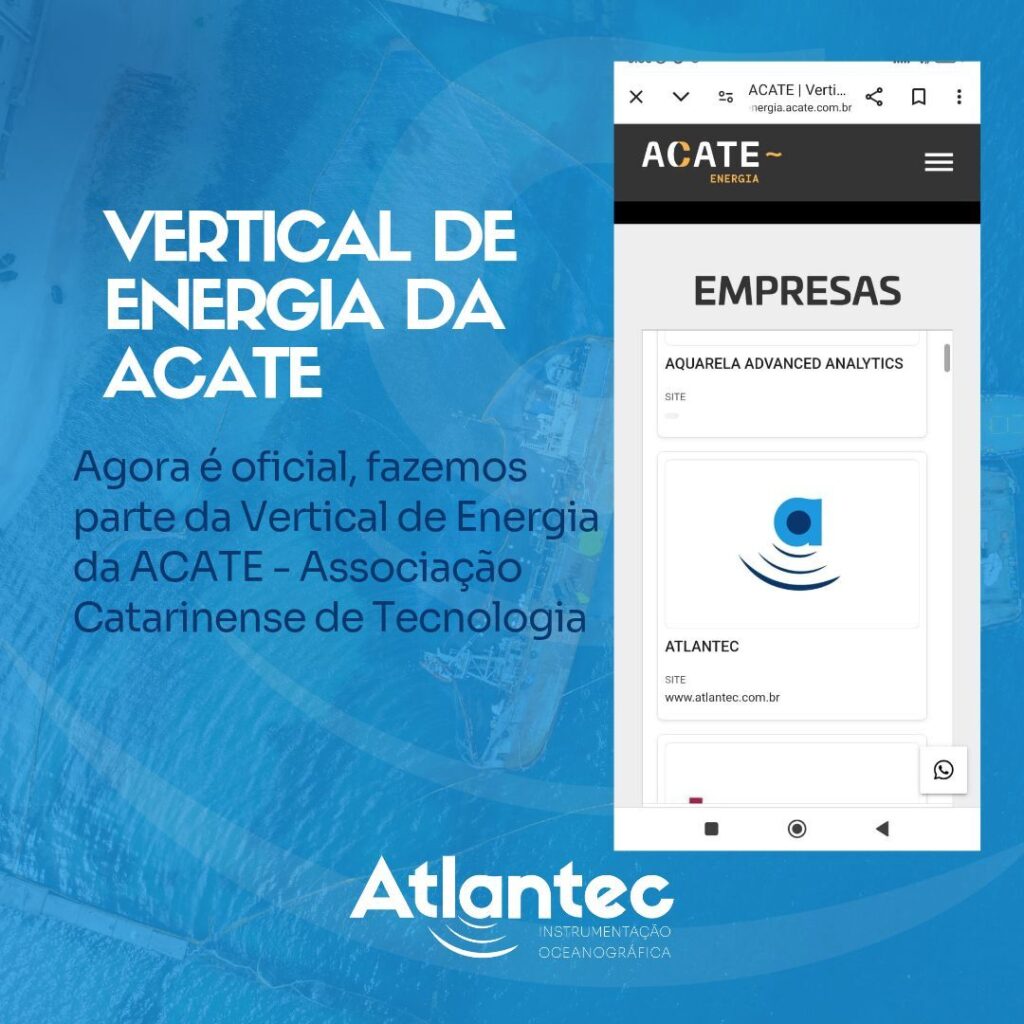
Officially we are participating in the Energy Vertical of ACATE – Santa Catarina Technology Association. A group of technology-based companies that work in the development and commercialization of solutions for the energy sector, whether oil and gas, wind, hydroelectric, solar, hydrogen,…This first meeting was very productive and we can’t wait for the next one to arrive.
1° Wiro – (Tradução Inglês)
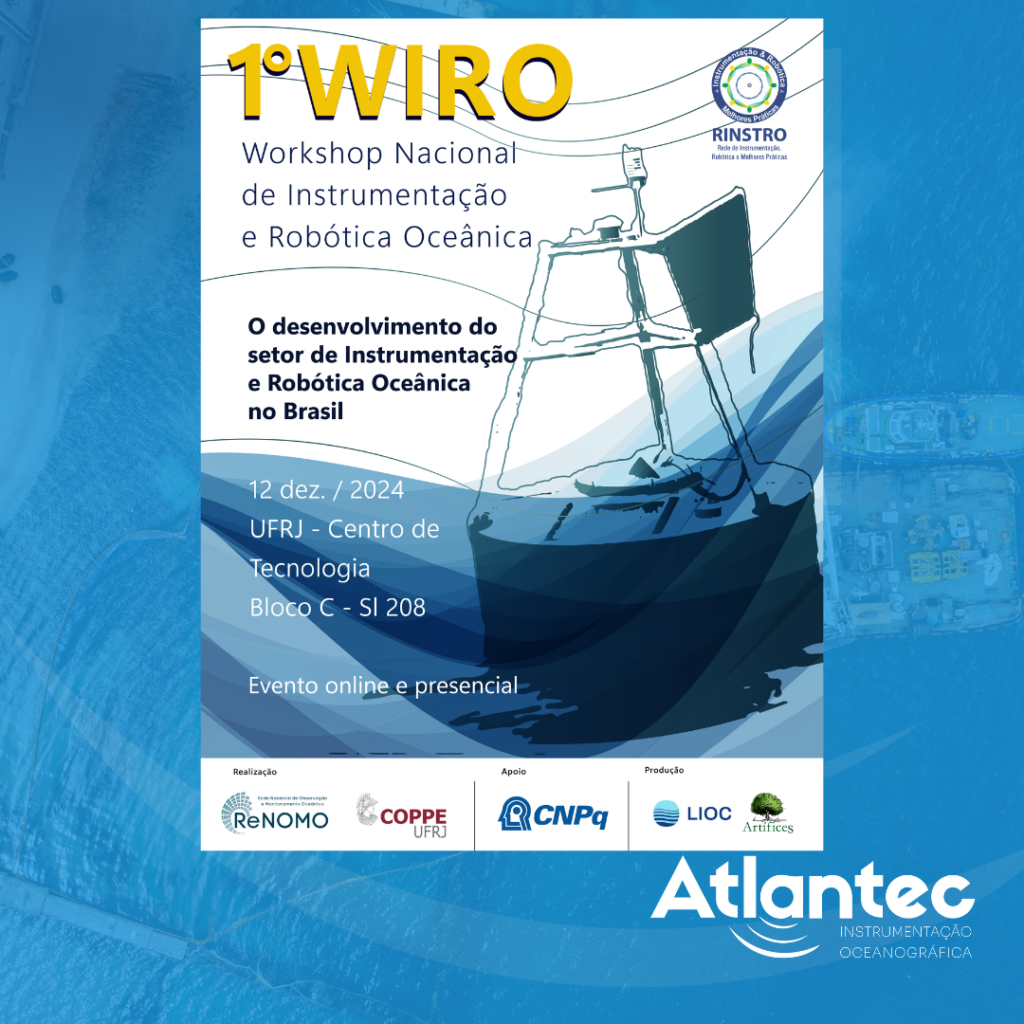
The 1st Workshop on Oceanic Instrumentation and Robotics takes place on December 12th.Our Electronics Engineer, Gustavo Batistell, will represent Atlantec, which has been actively supporting ReNOMO’s initiatives in partnership with LabECO and the Eco Sailboat from the Federal University of Santa Catarina. You can also participate online in this 1st WIRO, organized by LIOc/COPPE of UFRJ – Federal University of Rio de Janeiro. These are the RInstrO groups within ReNOMO, strengthening the foundations of Oceanographic Instrumentation at INPO – National Institute of Oceanic Research.